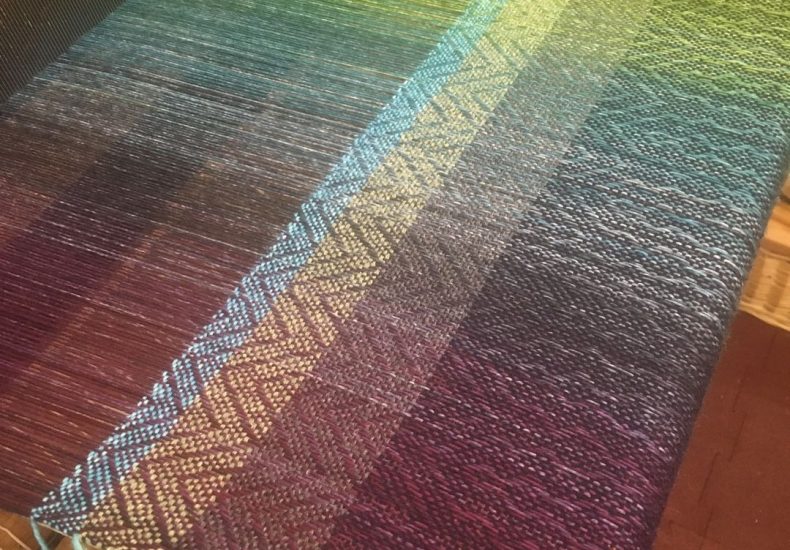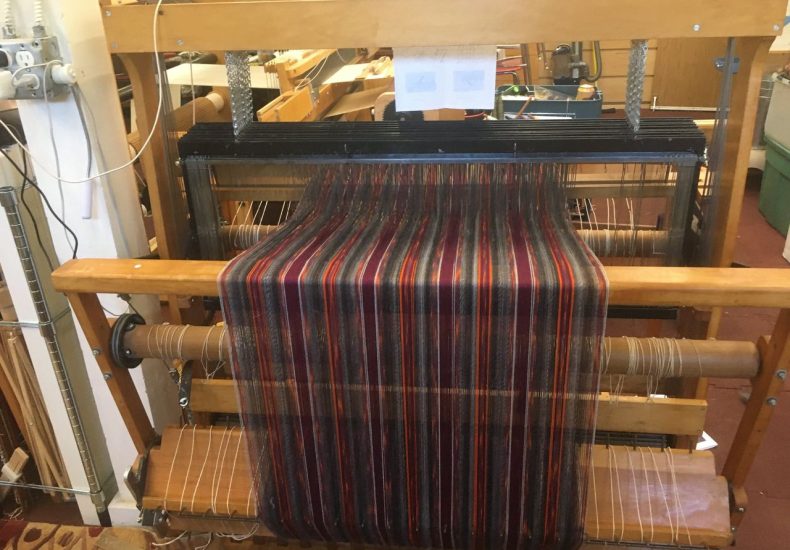
Henrietta spins!
I’m not certain if it was Stacey’s intention, but the name Henrietta and the merry mottled colors of this braid remind me of a book my Granny read me as a kid, The Tale of Henrietta Hen. I purchased the braid on a complete whim, after finding out from David that he & Stacey had been friends many years ago.
Here’s the braid:
And an illustration from the book:

So not a complete match for colors, but a reminder, one of the other. This braid is dyed on a striped base; it’s dark and light BFL. That means the singles will barberpole naturally. The braid also progresses from mostly light at one end to mostly dark at the other. I have been reading a lot about fractal spinning, where you make one ply of a full color transition and then the other plys are splits, and wanted to try that. I decided to split the brain in half, and then split one of the halves in thirds.
It didn’t quite work out that way; I ended up with uneven initial splits when I weighed them, so I took a fourth split off the single, and ended up with these:
The small split on the right in the basket has less of the dark color; it’s the final piece. I kept weighing it as I was splitting it to make certain I ended up with equal weights.
These are put up as crocheted crochet chains, btw. I find this a tidy way to store them, and easier to work from than the long ropes. I make a crochet chain, and then make a crochet chain from that, starting from the same end I started the first chain. That way as I pull the thinner chain to spin it, I’m also pulling the second level chain. Maybe this makes sense. It works well for me. :-)
I’ve started spinning, and I love it. Watching the colors transition is enchanting. I’m working on a low twist fluffy long draw, aiming for a sport to worsted-ish weight two ply. I keep plying the yarn back on itself to see what it looks like, and I’m happy with the yarn so far.
I’ll see what sort of yardage I get. I would like to make this into a little semi-circular shoulder wrap. If I don’t have enough from this braid, I may stripe it with another Stacey braid called “Wine Stains.” We’ll see!
knitting algebra
Knitting requires math. Whether I solve a problem physically by separating stitches onto multiple needles or with markers, or on paper, math is getting done. And math doesn’t have to be scary; particularly not knitting math where you have the object in question in your hand and can check your answer to make sure you got it right!
Today I am working on a pattern for a toe-up sock. I want it to be 60 stitches around. I have cast-on 24 sts and dutifully increased 4 sts every other row to get to my desired stitch count, worked the first row of the instep chart, and discovered a problem. The chart is 29 sts across, so I need to add a stitch.
Looking at the chart, the best way to do this is to add an m1 to the last instep increase round. On the needles I can fudge this easily enough by finding the middle two stitches and nudging them apart so I can create an increase a couple rows below. I hate ripping, and avoid it wherever possible, trusting blocking to find me the slack for those extra stitches.
For my directions, however, I’d like the knitter to be able to put the increase in the way they should, which means I need to figure out how many stitches they need to knit on either side of the centered increase. Perhaps I haven’t had enough tea this morning, but I needed to resort to pen & paper for this exercise:
I’m a bit handwriting challenged, so let me translate for you. I know I need the top of the foot to look like this:
P1, m1, k?, m1, k?, m1, p1.
I need that to add up to 31, which means I need to solve this:
2 + n + 1 + n + 2 = 31 sts
which is the same as:
2n + 5 = 31
which I can shuffle around to be:
n = (31 – 5)/2
telling me I need 13 sts between the m1′s, for a knitting row of:
P1, m1, k13, m1, k13, m1, p1.
That adds up to 31 sts! Yay for math!
This here blog thing
I believe I’m going to start recording my fiber noodlings here. I’ve been posting bits of my adventure in Ravelry groups and recording bits in project notes and photo sets, but it would be nice to combine it all into a single location where there was chronology and coherence, so it would be easy to back-track a project through all the steps from fiber acquisition to FO.
I have been staying pretty mute online because I wanted to preserve the publishability of things I make in third party press. I am not going to let that stop me any more. I have proven to myself that I can get published if I try. I am more interested in sharing my process right now, and that lends itself more to a blog than a pattern or an article.
I may ret-con a blog archive out of older bits or writing and photography that have been filed in various places, at least for the various in process things at the moment. But for now, I believe I shall regularly record my fiber noodlings. I think this can work and be good for me and hopefully helpful for others.
Note here that I’m giving myself wiggle room. I may not do this. I may do it fitfully. But I think it would be enjoyable, and a more fitting format for what I’m doing right now. We’ll See. If I can re-up the notebook commitment I made at the beginning of the year, which has been going reasonably well, and add in some blog time during morning tea and lunch as well as notebook entries, I should be able to do this.
To that end, I’ve been spinning. Lots. There are now five and soon to be six wheels in the house. I have the Babe that made me cry, which will be re-homed as soon as it’s repaired. I have the Kromski Minstrel I bought myself for Channukah. I have one Canadian Production Wheel I got from Craigslist for cheeeep, and a second I found via the CPW list on Ravelry. One of the CPW’s will also be leaving; probably the Craigslist wheel after rehabbing. David has an ancient (I believe) Irish flax wheel from his grandmother which she purchased as an antique right after getting married. And there’s a Moswolt M2 on the way from the Netherlands scheduled to be delivered any day now.
I have spun many miles of singles since the beginning of the year, and I’m looking towards making this a career by the time I’m 50, so this doesn’t feel excessive.
Lately, I have been spinning a braid called “Henrietta” that was created by Urban GypZ and some batts I made myself from merino/tussah and firestar at Northwest Handspun.
Henrietta has gone from this:
to this:
And the merino/tussah/firestar has gone from this:
to this:
I want to write about how I did these things, but that will wait til next time.
Spinning
I purchased my first wheel second hand about a year ago, and it was an old cantankerous thing that had seen more than its share of abuse. The day it made me cry, not because I wasn’t getting a technique I was practicing, but because the wheel kept binding on the frame and screeching to a halt, I knew I had to either quit spinning or buy a new tool. For the holidays this year, after everyone else’s gifts were settled, I bought myself a Kromski Minstrel, and she has opened up the joy if spinning to me in a way I had only glimpsed before.
I am wandering around lost in a world of strange terminology and unfamiliar concepts, but loving every moment. There is so much knowledge, but so few references that are approachable as a new person. It’s both fascinating and intimidating.
My first goal was to make fine laceweight yarn, and I’ve pretty much mastered that. Since I got the wheel, though, I’ve been branching out. David bought some yak down for me to spin when we got the wheel. He wants a yak scarf. I wanted a fluffy yarn for that, so taught myself long draw, and made it into a fulled single. It’s a delicious, squishy, fluffy skein now, and I’m working on the design for it. I am captivated with the idea of spinning diaphanous woolen yarns.
Last night I tore up 4 oz of roving from DragonFibers, sorting it by color, and then mussing up the fiber, first making pseudo-rolags but then tearing it up and crossing the fibers every which way and spinning the random bits as the presented themselves. I filled two bobbins with what is probably a couple hundred yards of single. My plan is to run it back through the wheel and attenuate the really chunky bits, then ply it with some purple lace weight.
I have an idea of having it start out fine but then get progressively chunkier, and knitting it in pattern that follows the yarn; first a fine pretty lace pattern, expanding into a bigger and bigger pattern as the shawl expands. I want to design the yarn and a pattern for Melissa; a half circle shawlette. I want to evoke dragonflies with the project.
I like this idea of spinning, designing a pattern, and knitting a project inspired by a person. Melissa is first. I think there will be others.
All Will Be Well
This song captured me yesterday. We were driving home from a visit to the Peninsula, in the dark and fog, trying to hustle to beat the threatening snow, after a beautiful, happy, and fulfilling day, and I was struck by how happy I am. All is well. Truly. Life is good. As Gabe says, I am practicing my purpose once again.
We got up and out early, and raced onto the ferry. Z & David practiced for Z’s latest role; he’s the Music Man in The Music Man at school. I knit on my silk purse project bag, and listened, helping to prompt Z as I could, and explaining bits of the plot to him. Giving him context, explaining a bit about grifting. All of us being happy, and practicing things that bring us joy.
We had a delicious breakfast at a cafe in Bainbridge, then drove to our friends in Port Townsend, arriving around noon. Chris and Patty have 20 acres of woods and fields with creeks and critters, and it’s always so beautiful and inviting there. We hung out a bit, until Chris took the boys out on a tromp through the forest and fields, and David, Patty, and I headed to Port Gamble to visit with Heidi.
Heidi’s studio The Artful Ewe was gorgeous and inspirational as always. I gave her a moment of stress when I said, “I brought back my wheel;” she thought I meant I was trying to return it! but then we sat and spun, and helped Patty with her socks, and put a spindle in her hands, which seemed to go well. She and Heidi hit it off, as I had hoped they might. Now Patty can help Heidi with shop chores, and Heidi can help Patty with knitting and spinning and dyeing. I love introducing friends who should know each other!
We had wanted to have dinner with the Ferry’s, but the threat of snow sent us scurrying for home. We stopped in Poulsbo, though, when it was clear that we were beating the storm. Had mediocre Indian, but found ice cream at Mora that rivals our beloved Capo Giro in Philadelphia. Z & D ran through the script again on the boat home, while I worked on a Secret Project.
The what of the day wasn’t as important as the how, though. We were happy. We were productive. We were with friends in a beautiful place. We were all looking forward to practicing our passions, and were supporting each other through it. Our relationships are deepening, and it feels so good.
This is my life. I have a comfortable job, and home. I have a lover who is a friend, a son who is a delight, a craft that brings me pleasure and fulfillment. I am making good friends, who enjoy each others’ company. My life is good.
Beamish
PDF here: Beamish
‘And hast thou slain the Jabberwock?
Come to my arms, my beamish boy!
Oh frabjous day! Callooh! Callay!’
–from “Jabberwocky” by Lewis Carroll
This scarf is a tale of two knitters, a Ravelry love story, and a spat over stash.
I met David online two years ago today, in the Ravelry forums. We immediately struck up a long distance friendship, soon met in person, and later fell in love. During the same period of time I went through some life changes that necessitated a move to Seattle. This summer, David decided to join me here.
As part of the moving preparations, I flew down to Texas to help him get organized: the fun part was sorting his stash! During that process he told me I could have anything I wanted, since he was approaching SABLE and felt guilty for all of the lovely yarn languishing in his care.
Moving interrupted his work on a pair of kilt hose he had promised for a wedding, so when he arrived he was too far behind to meet the deadline. I picked up one of the hose, and ended up working about half the project for him. There were many late nights. He ran out of yarn about half an inch too soon. Pawing through his stash for a substitute, I found this skein of Jabberwocky. Between remembering the earlier offer and in light of the work I was doing for his deadline, I asked for it.
It turns out this particular skein was very special, having been purchased on a trip several years before we met. Much hilarity ensued. Finally, we agreed the yarn could live in my stash, and whoever picked it up to knit first could have it, so long as they didn’t let the WIP languish.
Of course I cast on the next day.
I wanted to create a scarf that would be a quick, interesting knit and would use exactly one skein of flashy hand-painted yarn. (Don’t we all have a couple of those in our stashes?) It needed to showcase its wild colors without flashing and pooling, in a firm, thick fabric that wouldn’t roll. In other words, it had to be perfect. I looked at a lot of patterns, swatched about a dozen different stitches, and finally came up with this pattern. It’s worked longways, giving it the stripes of pattern along its length.
Every time I put down the project and worked on something else, David would threaten to rip it, or to start knitting from the other end of the skein. I talked about wearing the scarf and never letting him so much as touch it, and about giving the FO away to various people. But in the end, for David’s birthday, I gave him the finished scarf wrapped around a new skein of Jabberwocky. Love is a frabjous thing.
FINISHED MEASUREMENTS
6 x 60 inches
MATERIALS
Blue Moon Fiber Arts Socks that Rock Heavyweight [100% superwash merino; 350 yds / 7 oz skein]; color: Jabberwocky; 1 skein
1 32-inch US #8/5 mm circular needle
a second 32-inch US #8/5 mm or smaller circular needle to use for grafting
notions required:
waste yarn
row counter
yarn needle
chocolate
GAUGE
25 st = 3.25 inches in horizontal herringbone stitch (washed and blocked)
25 st = 3.5 inches in linen stitch (washed and blocked)
PATTERN NOTES
Crochet Cast On:
Using waste yarn, work a crochet chain several sts longer than the number of sts to be cast on. Starting 1 or 2 sts in from end of chain and using working yarn, pick up and k 1 st in the back loop of each ch until the required number of sts have been picked up. Later, the chain will be unraveled and the resulting live sts picked up.
Linen stitch:
This fabric has a knit side and a purl side. You will work every other stitch on each row. The slips and the knit sides of the stitches always face the right side of the fabric, and the backside is just purl bumps. The edges are a single column of garter.
Row 1 (RS): k1, *sl1 wyif, k1; repeat from *, k1
Row 2: k1, *sl1 wyib, p1; rep from *, k1
Horizontal Herringbone stitch:
This fabric also has a knit and a purl side, but you work two stitches at a time. There are several tutorials on YouTube for this stitch pattern if you get lost.
Row 1 (RS): k1, *sl 1, k1, yo, pass slipped stitch over both the new stitch and the yarn over; repeat from * to last stitch, k1.
Row 2: *p2tog, then purl first stitch again, slipping both stitches off the needle; repeat from * to end of row.
The cast-off in this pattern is completed using Kitchener Stitch (grafting). An article about this technique can be found here.
PATTERN
The cast-on and cast-off for this pattern give matching edges that are firm without being tight. Done correctly, they will look identical.
Tubular Cast On
Using waste yarn, crochet CO 190 sts.
Using working yarn, work as follows:
Row 1 [WS]: K1, [k1, yo] to last st, k1.
Row 2 [RS]: [Sl 1 wyif, k1] to end. [380 sts]
Row 3 [WS]: Sl 1 wyif, k1, sl 1 wyif, p to last 3 sts, sl 1 wyif, k1, sl 1 wyif.
Remove waste yarn; the edge will not unravel.
Body
Work Linen Stitch for 8 rows.
Work Horizontal Herringbone for 6 rows.
Repeat these two sections two more times, so that you have three stripes of Linen, and three stripes of Herringbone, alternating.
Finish with 10 rows of Linen Stitch.
Tubular Cast Off
Last row (RS): k1, *sl1 wyib, k1; repeat from *, k1
Using working needle and second needle, slip across, moving every other stitch to the second needle, so that the stitches worked on the RS are on one needle, and the stitches worked on the WS are on the other.
Now comes the grafting. Get your chocolate and your yarn needle. You will need a yarn tail about 3 times the length of the fabric, or you will need to join on new sections of yarn as you work.
There is one option that avoids joining on several times and subsequently weaving in lots of ends. It is to fold the entire length of yarn you will need to complete the graft in half and half again, and pass the loops through the eye of the needle. This way you are pulling several thicknesses through each stitch at once rather than having a very long piece of yarn to pull through. You will work only one thickness of yarn in the graft just as you ordinarily would; but this technique lets you pull the tail through more easily.
Kitchener across the edge from the two needles until all stitches are bound off, applying chocolate liberally as needed.
FINISHING
Weave in ends.
Wash & block; the pattern opens up nicely when you take the time to pin it out!
Red Velvet Cake with Cream Cheese Frosting
Oh, my, I just realized the cake has not been written up. I’ll need to get a photo the next time I bake it. But here’s the recipe.
This is *the* cake. Friends request it for special occasions. They discuss it among themselves and with other people in hushed voices. They rave about it, and marvel that it is so delicious. Because, you see, the main ingredient is beets.
I went on a kick trying to make a traditional red velvet cake that was actually red without adding food coloring. I never quite got there, because I always wanted it too chocolatey. I expect if I reduced the cocoa and used unprocessed (not “Dutch” or “Dutched”) cocoa I would get there. But this is too good as is to really go mucking about.
The cocoa I use and recommend for this recipe is from World Spice Merchants here in Seattle, and is called Mayan Cocoa. It has chili and ginger and cinnamon and other stuff in it, and compliments the recipe enormously.
It is possible to use canned beets with this recipe. I choose not to most of the time, mostly because I try to avoid the can whenever possible. Boiling down the beets takes a good long time, though, so when I want to make this on short notice I’ll generally use canned. Do what’s right for you.
Red Velvet Cake with Cream Cheese Frosting
Ingredients:
- 2/3 C cocoa
- 2 & 1/2 C cooked mashed dark-colored beets (supplement with apple sauce if you end up with less)
- 1 T vanilla
- 1 C sugar
- 1/2 C sorghum flour
- 1/2 C corn flour
- 1/2 C tapioca flour
- 1/4 C potato starch
- 1 & 1/4 t xanthan gum
- 1 & 1/2 t baking soda
- 1/2 salt
- 3 eggs, beaten
Chop the beets into small-ish pieces, and put into a food processor or blender until pureed. Then dump out into a saucepan. Add a little water, initially, if the beets seem too dry at the start; you will boil it off at the end. Simmer covered over low heat for about 3 hours, or until the mix is the consistency of applesauce. Remove the lid and cook off some of the remaining liquid until you can see the bottom of the pot when stirring with a spatula. Allow to cool enough so that it won’t cook the eggs when added.
Preheat oven to 350. Coat two 9″ circular cake pans, or a 9×13 rectangular pan, with cooking spray and cornstarch or tapioca flour.
In a stand mixer or with a hand mixer combine beets, cocoa, and vanilla until well mixed.
If you are using the recommended cocoa mix, put it through a spice grinder or coffee grinder, and then sift, so that all the little chunks of spices are chopped up fine or removed from the blend.
Mix the dry ingredients together in a separate bowl.
Add the dry ingredients to cocoa mixture, a little at a time. Blend in eggs. If the batter seems too thick, add enough water to make a good cake batter. Beat two minutes with an electric mixer.
Divide mix evenly between the pans. Spin the pans to spread batter up the sides– this prevents the cake from ending up domed on top. Bake for 25-30 minutes.
Remove from oven. Cool in the pan for a couple minutes or until the cake starts pulling away from the sides of the pan. Flip out onto a cooling rack.
Cream Cheese Frosting
Ingredients:
- 1/2 cup of butter (1 stick), room temperature
- 8 oz of Philly cream cheese (1 package), room temperature
- 2 – 3 C powdered sugar
- 1/2 C corn starch (maybe)
- 1 T of vanilla bean paste (or vanilla extract)
- 1 t orange oil
This is going to sound like a lot of mixing, but really, trust me. Adding all the air by beating these FOREVER is what makes it good.
Cream the butter in the stand mixer with a paddle or with a hand beater for 2 minutes. Add half the cream cheese, 2 more minutes. Add the other half, 2 more minutes. Add the orange oil and vanilla bean paste, and, you guessed it, 2 more minutes. Trust me, it’s worth it.
Fold in the powdered sugar a little at a time, until the mixture thickens to the right consistency for a spreadable icing. If you get much past 2 C of sugar, you may find it works better to add a little corn starch to thicken it up the last bit. This is particularly a good idea in warmer weather, where butter cream frosting tends to melt on the cake. The corn starch helps it stand a little more heat.
Beat on high another minute.
Let stand at least 15 minutes or until the cake is COMPLETELY cool before frosting.
Ant War
I am at war. The ants and I fought to a draw last Fall, but they are back with a vengeance. They have numbers and determination and chaos theory on their side. All I have is intelligence, tool making, and opposable thumbs. The best I can hope for is to fight them to a draw, but I am giving it my all. I am manically obsessively tidy and clean in the kitchen, and ants are NOT welcome to share it with me.
Yes, I know there are all sorts of chemicals I could use to get the upper hand in the battle, for a while. But let’s remember, people, that this is my kitchen. I live here. My primary tools in this battle are borax and orange clean spray. I’m just not willing to use anything more toxic. so I have to get crafty.
They have been mustering their forces for a couple weeks now, and I’ve been watching with some trepidation, and searching for my round tuits. I’ve swiped them off the counters whenever they’ve made an incursion, and kept my vigilance up in the cleaning department, making sure there was never a dirty dish on the counter or in the sink, never a crumb lying around to tempt them to make a sortie.
Today, though, they crossed a line. I opened the upper cabinet next to the stove where I keep the sweet things– all in hermetically sealed containers, because I am not a n00b in this war– and there they were. Somehow, they had found the prize. That was it, I had to engage.
Let me pause for a moment to explain these ants. I’ve never encountered them anywhere but the west coast. They don’t bite. They are tiny and mostly black. A little bit of googling makes me think they are probably “little black ants,” or Monomorium minimum. They are, simply, everywhere. That site suggests you can manage them with bait traps. This has not been my experience. I put out bait traps when I first moved in, to no obvious effect. I renewed them a week ago after the ants started appearing again, but they seem to laugh at the traps.
I will state for the record that I would far rather be dealing with these little guys than fire ants, and perhaps I should just quit my bitching. But I’m not gonna, so there. :-P
It took me several years to fight them to a draw in California, and I bring those skills to the table. In that house, I was able to seal most of the house to reduce their access points to the doors and windows, where I put down a line of borax. This helped, but was not, in the end, sufficient. I’m not sure if it’s sad or funny, the things I did to defend my kitchen from the ants. Sugar jars in water moats. Trying to find and destroy the ant colonies outside. The garden folks told me this wouldn’t help. There were too many ants. They told me I could, perhaps, destroy a colony, but that would just open up a territory for the colony next door. I’m not sure of the mechanics, but they were right that it didn’t work.
What finally succeeded at managing them was an accident. You see, I came home late one night, tired from dancing, and wanted to make tea. I puttered about in the ambient light of the kitchen doing that thing, and reached for the cute little honey jar I had at the time. It was white ceramic shaped to look like a bee hive with one of those wooden honey drippers in it. I thought it was adorable.
The salient point here is that I had gotten cocky, and left something sweet on the counter in an unsealed container. Which I discovered when I innocently picked it up, and immediately had ants crawling all over my hand.
To my credit, I did not drop, or fling, the honey jar. I walked out the kitchen door to the garage and set it down in the back corner, to deal with the following day, then returned to the kitchen swatting and flinging ants and cursing. I scrubbed my arms, washed down the counter, and went to bed with my tea, fully expecting half the colony to have moved into my kitchen by the morning.
Much to my shock and surprise, the kitchen was 100% ant free in the morning. The honey jar in the garage, however, had a thick swarm of them, and a trail I swear was an inch wide going back and forth from a crack under the back wall and back. I had an AHA! moment. What the ants demanded was a tribute! And, really, was a container of honey so much?
Now I wanted my little beehive jar back because I’m stubborn that way, so I found a little plastic container in the recycling, put on my big girl pants, and picked up the beehive jar. I poured the honey into the container until I couldn’t stand the ants crawling on me any longer, and ran into the kitchen to wash my arms and the jar off in the sink.
The ants accepted my tribute. Eventually I switched to a plastic plate with sugar on it, but I renewed the sacrifice whenever it seemed to need it, and the ants mostly left my kitchen alone.
I made a similar tribute shortly after moving in here, when they found my box of sugar cubes. Living on the east coast had made me soft. The ants out there will bite you, but they mostly seem to prefer to live outdoors. So I had, unthinkingly, left a container of sweet stuff unsealed in my cabinet. Once the ants found it and I realized my error, I transported it to the wall outside the kitchen, and the ants happily accepted it. It was a cardboard box, though, and this is Seattle. It was enough to appease them until the rains and the cold came, but now that spring is warming up the world, they are back, and they want what’s theirs.
I cleaned the kitchen today, scrubbed every surface to get rid of the trails, and discovered, much to my horror, that they had moved into a narcissus pot on the kitchen windowsill. I tried to drive them out by drowning- leaving the pot standing in water for a while- but after a half hour of letting it sit for a bit then lifting it out of the water to see more ants come swarming, I decided they could have the damned narcissus bulbs, and put the pot out on the porch. I don’t like narcissus that much anyway, and they are done blooming.
I also built the vessel of my tribute, Seattle style. A Darigold sour cream container now has a couple holes about 1/2 inch up the sides, and the lid on. I know the tribute will need to stay dry. I have put some cactus honey powder in the jar, and sprinkled some on the counter closest to where the ants always emerge from, coming from a gap that’s too wide to seal between the cabinets and the wall.
I know they will return, and find the tribute, and I can locate it in a place that’s not in my kitchen. Hopefully that will keep the truce, for a little while.
Waffles, reprise
I had to try them again.And because I’m me, I had to try to make them better. I used more or less the flour blend from Gluten Free Girl’s cinnamon rolls and this is what I got:

And this is how I made them:
Waffles, reprise
- 1 oz almond flour
- 1/2 oz tapioca flour
- 1/2 oz corn flour
- 1/2 oz white rice flour
- 1/2 oz potato flour
- 1 T sucanat
- 1 T buttermilk powder
- 1/4 t xanthan gum
- 1/2 t baking soda
- 1/4 t salt
- 1 T vanilla
- 4 eggs
- 1/4 C water
whisk together the dry ingredients, then add the wet and whisk to combine. Cook until uniformly golden and crispy.
Releasing
Tonight has been a hard night. I really don’t know why it’s been so hard. Work wasn’t unusually stressful. Life wasn’t unusually stressful. I’m getting therapeutic massage to try to deal with some long term spinal issues that cause me occasional pain and numbness in my arms and hands, and that was profoundly, well, therapeutic. I got a lot of immediate relief from the symptoms, and I expect the work we did will lead to long term improvement, as well. Myofascial release is amazing. That was the most effective bodywork session I think I’ve ever had.
None of that changed the fact that I’m feeling bluesy and needy and very much alone tonight. I think this is the first time it’s hit this hard since I moved here, which is a testament to how well I’ve been coping, overall, with the changes. Driving home from the therapy session it started settling in. I thought about looking for something to do that would involve going out and being with people, but decided it was better to sit with my feelings and try to release them rather than dodging them. So here I’ve sat tonight, knitting and petting cats and watching Caprica.
PMS is probably a factor in my mood, as is February. This month is the nadir of my affect more or less every year. The darkness has really gotten to me by this point, and even though the daylight is getting longer and longer, there still isn’t a whole lot of it. I knew February would be hard back in June when I found out these changes were coming, and I’ve been building my life to be ready for it. I’m feeling pretty good about how it’s going so far. Sure, it’s only day 5, but I’m in a good place heading into the month.
Generally I’m approaching the bluesy mood by working first on the physical things that are easy to set to rights: eating better, exercising more, and sleeping reasonable and regular hours. Being physically in a good place is the first, best defense against the down moods.
I’m also returning to my yoga practice. The myofascial release work is directly related to this; I want to stretch more, and work on my alignment and balance, integrating the work I’ve done on the table with a more dynamic practice. I discovered this week that my cubicile is private enough, and has enough open space, that I can practice most yoga poses without being seen or disturbed. I’m getting up and running through Sun salutes between meetings, or another flow that I’ve been liking which is a runner’s stretch into Warrior I into triangle, then rotating to do the sequence in the other orientation. Warrior I has always been energizing for me, and that is still true.
Seattle is being kinder than I expected to my mood, because it’s clearly already spring. I’ve spent several of the afternoons this week starting to work on my garden, and this weekend there will be much gardening accomplished. I am stripping the vegetation off the majority of the back yard, and laying out a vegetable garden. I haven’t decided for sure the layout for it, but step one: “clear the area” will be the same no matter what. I figure I can look at it tomorrow while I’m digging, and hatch a plan.
Part of me wants simple rectangular beds. Part of me wants a stepping stone garden, like what I had in Santa Cruz years ago. Part of me wants a labyrinth. It will be interesting to see what comes together from those parts. :-) I’ll measure thoroughly as part of the work tomorrow, and then sketch tomorrow night. Where by sketch I mean “pop open a graphical editor and move around stuff.” The paper and pen stuff is sooo last millennia.
I’m expecting to establish herbs near the back door, but mostly plant annuals in the majority of the garden area: veggies, and a few flowers. I’m going to leave the perennial beds around the edge this year, just trying to prune the decadent growth back into vigor, and see what is there. I may do a major restructuring in the fall, but I want to watch it through a full turn of the seasons before deciding.
I’m setting off to the side the well rooted perennials that have seeded into the area. Some of them I can identify, and some I think I recognize. All of them will be set into a narrow bed along the south edge of the property, against the fence, where they can’t get up to much trouble. Eventually that bed will be ferns, hostas, and Japanese forest grass, but for now it’s a nursery.
Creatively, I’ve made reasonable targets for myself, and am taking great pleasure in more or less meeting them. The sock pattern is coming along nicely. I hope to have the instructions for knitting the foot fleshed out a bit more, the sizing information worked through, and a clean draft created by the end of the weekend. That sounds like a lot, but should only be a couple hours work.
In life generally, I’ve taken a step back, sorted out my priorities, let go of the guilt I pile up on myself when I can’t do everything and be everything for everyone, and I’ve put things more or less in order. I am making slow progress against my goals, and I’m comfortable with that. Every day a little more. Not a lot, but enough. I am still rooting in, still healing. This is not a time for big glorious growth yet, this is still a time for recovering and letting go.
Tomorrow there should be pictures. I want to shoot the two WIP’s I have going, and also lay out a garden design draft. For now, though, it’s time to sleep.